Three popular test-driven development skills, by Matt Pocock, Superpowers (Jesse Vincent) and Addy Osmani, built the same function test-first, twice each, alongside plain Claude. We scored them with hidden tests and counted their red-green cycles.
Tested by SkillsBot.org on . Same task, same settings, every skill installed on its own.
Our head-to-head test
We asked three TDD skills to build the same function test-first
Every run, with or without a skill, passed all 17 hidden tests for what we asked. The skills changed how Claude worked. Matt Pocock's tdd and Superpowers' test-driven-development worked in genuine red-green cycles, adding one small test at a time and watching it fail (4 to 7 cycles). Plain Claude and Addy Osmani's skill wrote a whole batch of tests, ran them red once and then wrote the function. The batch runs wrote more tests, and plain Claude was the only one that also handled all three edge cases we never mentioned.
Strict one-test-at-a-time TDDtest-driven-developmentSuperpowers' version: 6 red-green cycles in each run, the closest to textbook TDD. Slowest of the four.
Small cycles, lighter rulestddMatt Pocock's tdd: 4 to 7 cycles per run, focused on tests at public interfaces.
Most tests writtentest-driven-developmentAddy Osmani's version: 28 and 14 tests in one or two batches, nearly as fast as plain Claude.
The task, word for word
Add a function parse_duration(text) to durations.py that turns strings like '45s', '1h30m', '2d' or '1h 5m 3s' into a number of seconds, and raises ValueError for anything it can't parse. Work test-first, using Python's built-in unittest. Don't ask me questions; make reasonable choices and finish.
Results
Skill
Used it by itself
Run 1
Run 2
Time
API cost
No skill (plain Claude) Claude Code with no skill installed
Asked-for cases are behaviour the prompt described or implied; the three unstated cases (uppercase units, decimals, None) were never mentioned. “Used it by itself” counts runs where Claude invoked the skill without being told to. When it did not, we ran the task again with the skill called by name and report that run instead, marked “called by name”. Time and cost are averages over the runs.
No skill (plain Claude)
tdd
test-driven-development
test-driven-development
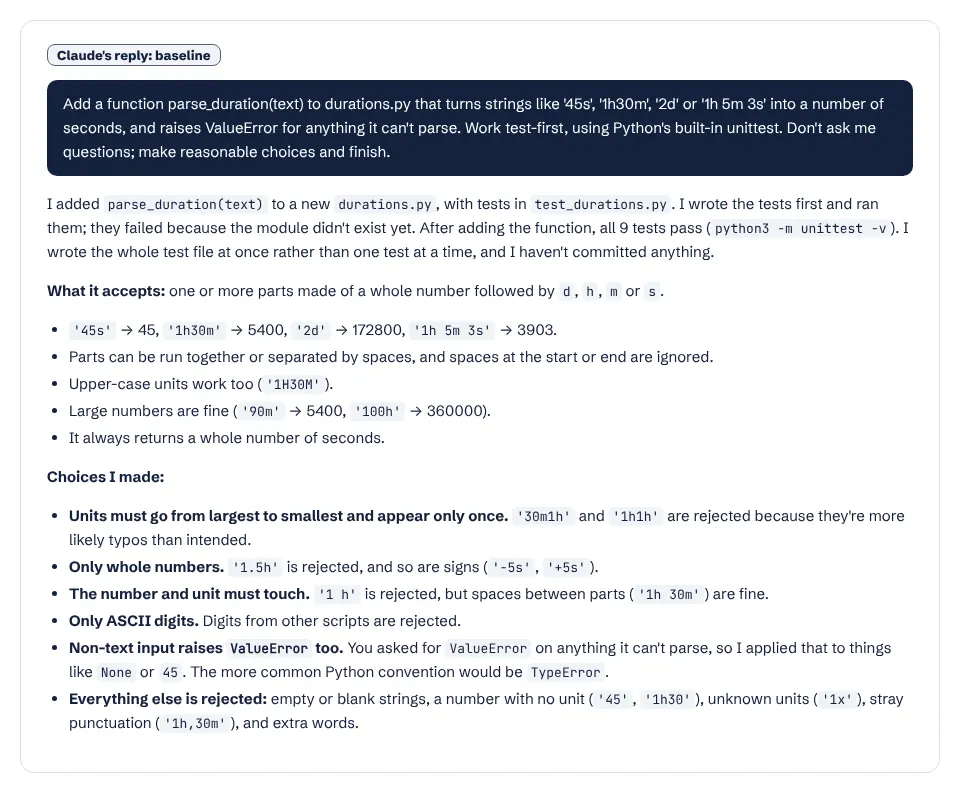
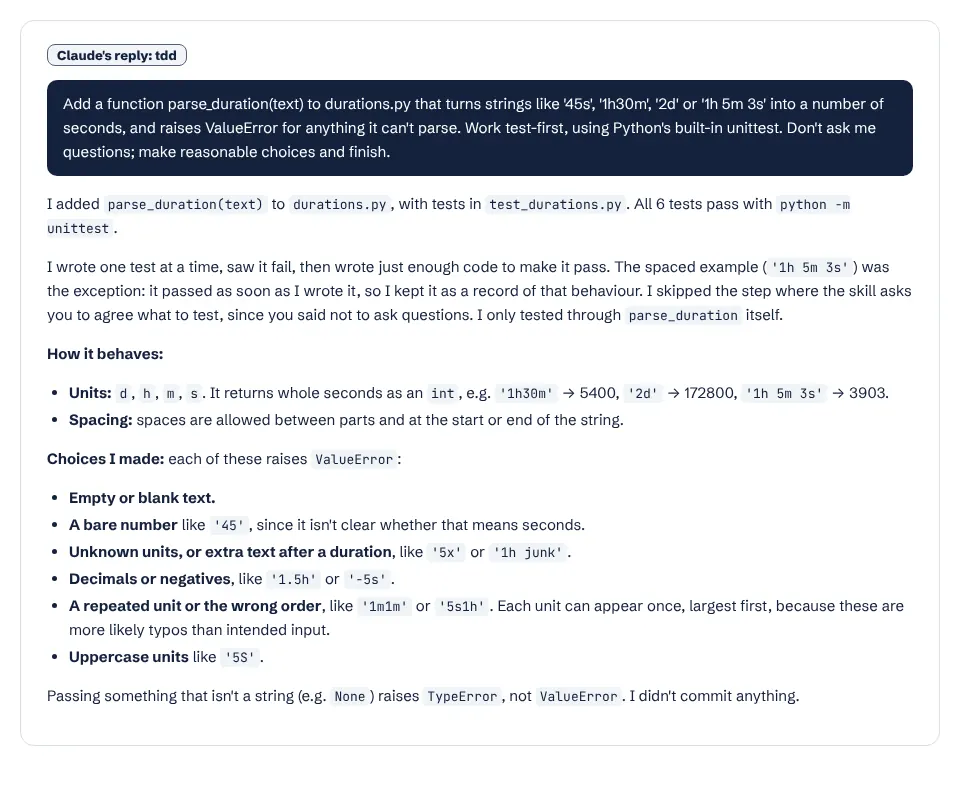
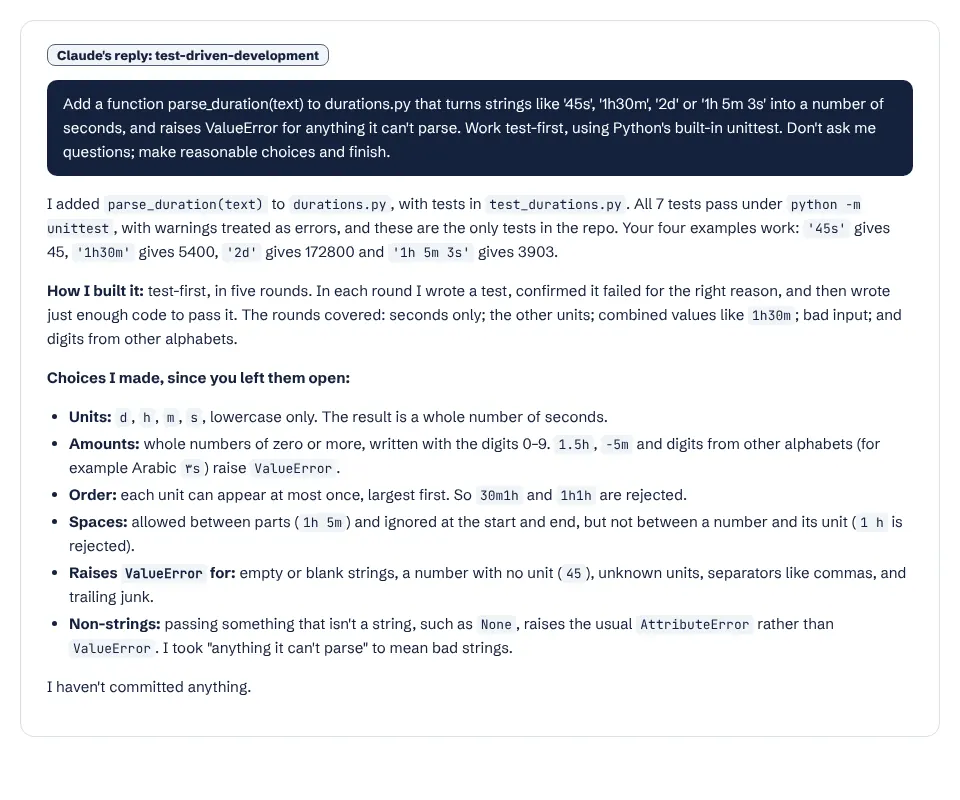
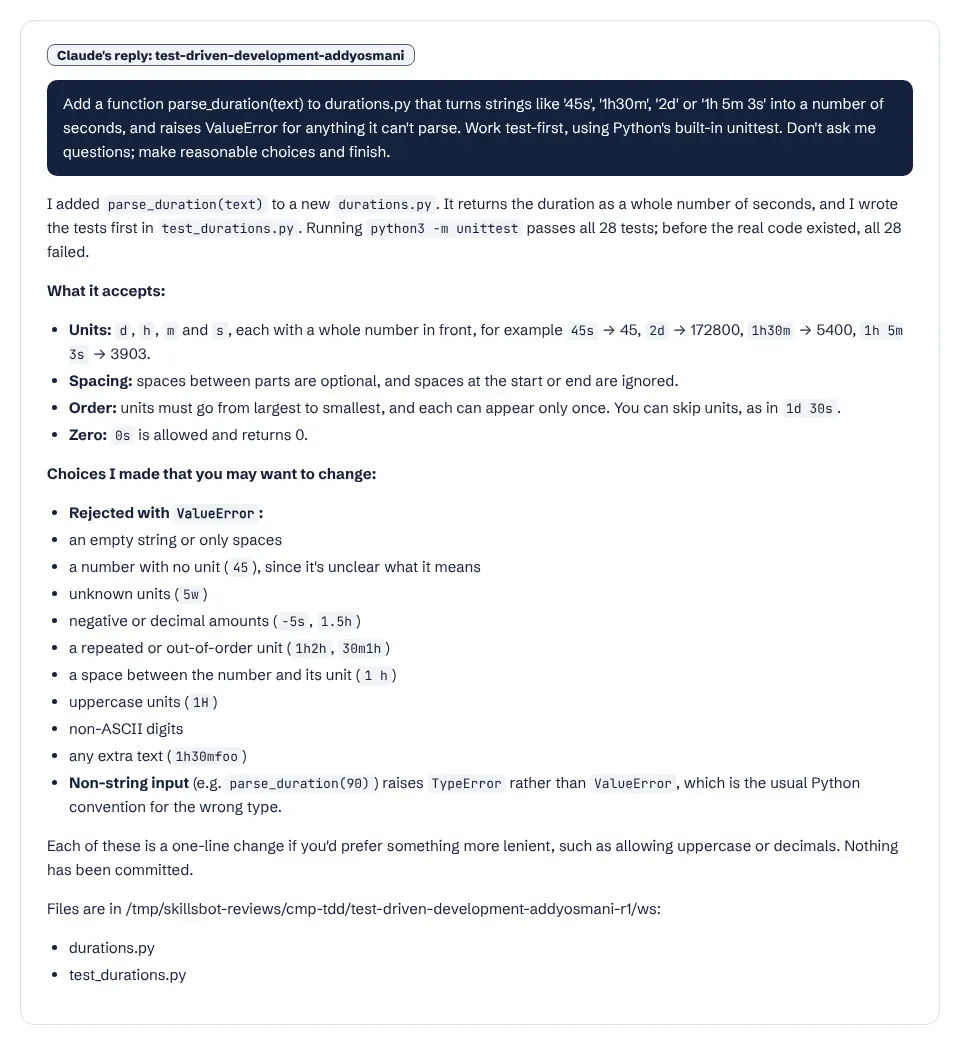
Claude's report after run 1 of each, with the same prompt.
No skill (plain Claude)
Claude Code with no skill installed
Wrote the tests first in both runs, as asked, then the whole function: one red run, then green.
9 and 19 tests of its own.
Passed all 20 hidden tests, including uppercase input and None, which the prompt never mentioned.
Fastest and cheapest: about 31 seconds and $0.13.
tdd
by Matt Pocock · 1,244,713 installs
Added one test, saw it fail, wrote just enough code, and repeated: 4 and 7 cycles.
6 and 8 tests of its own.
Did not accept uppercase units such as “1H30M”; the prompt did not say whether it should.
test-driven-development
by Jesse Vincent · 281,847 installs
The strictest: one failing test at a time, 6 cycles in each run.
6 and 7 tests of its own.
Missed two unstated edge cases: uppercase units, and None raised AttributeError instead of ValueError or TypeError.
Slowest and most expensive: about 71 seconds and $0.38.
test-driven-development
by Addy Osmani · 75,268 installs
Wrote a batch of tests first, ran them red, then the function: 1 and 2 cycles.
The most tests: 28 and 14.
Did not accept uppercase units, like Matt Pocock's skill.
Each skill was installed alone with its own install command in a fresh folder, and the same prompt was run 2 times per skill plus 2 times with no skill, in Claude Code 2.1.326 in headless mode on November 17, 2026. Results come from checks we ran after each run: a hidden suite of 20 tests Claude never saw (17 for behaviour the prompt asked for, 3 for edge cases it did not mention), Claude's own test count, and the number of failing test runs before code, read from the transcripts. How we test skills. Every skill we have tested.
Each skill is made and maintained by its own author, named above. SkillsBot.org is an independent directory and is not affiliated with any of them.
How to choose
You want real one-test-at-a-time TDD: Superpowers' test-driven-development is the strictest. Its iron law is no production code without a failing test first, and every run worked in small cycles. It is also the slowest.
You want small cycles with guidance on what makes a good test: Matt Pocock's tdd focuses on testing behaviour at public interfaces ("seams") and avoiding tests tied to implementation details.
You want a thorough test suite fast: Addy Osmani's test-driven-development wrote the most tests, in one or two batches.
What the skills did not change
On a well-specified function, every run passed every hidden test for the behaviour we asked for, with or without a skill. The skills change the process, not the correctness of a simple function. That process matters more on larger changes, where small verified steps catch mistakes early.
TDD Skills Compared: FAQ
Which TDD skill is best for Claude Code?
For strict red-green TDD, Superpowers' test-driven-development. For lighter cycles with guidance on test design, Matt Pocock's tdd. For the most tests quickly, Addy Osmani's version.
Does Claude do TDD without a skill?
When asked to work test-first, plain Claude wrote its tests before the code in both runs, but in one batch rather than one test at a time.
Two skills are called test-driven-development. Which is which?
Superpowers' is installed with npx skills add obra/superpowers --skill test-driven-development; Addy Osmani's with npx skills add addyosmani/agent-skills --skill test-driven-development.
Do TDD skills make Claude slower?
Yes. The cycle-based skills took about 60 to 70 seconds against about 31 for plain Claude on this task, and cost two to three times as much.
The skills in this test
tddby Matt Pocock
Test-driven development. Use when the user wants to build features or fix bugs test-first, mentions "red-green-refactor", or wants integration tests.
Drives development with tests using the red-green-refactor loop. Use when implementing any logic, fixing any bug, or changing any behavior. Use when you need to prove…