SkillsBot.org

Debugging Skills Compared

Matt Pocock's diagnosing-bugs and Superpowers' systematic-debugging are the two most installed general-purpose debugging skills on skills.sh. We gave each the same customer-reported rounding bug, twice, alongside plain Claude, and checked the fixes with hidden tests.

Tested by SkillsBot.org on . Same task, same settings, every skill installed on its own.

Our head-to-head test

We asked two debugging skills to find a penny rounding bug

On this bug the skills made no difference. All six runs, with or without a skill, found both causes: floats cannot store amounts like 5.225 exactly, and Python's round() rounds halves to even. All six moved the money maths to Decimal with half-up rounding, fixed the same bug in VAT that the report never mentioned, added regression tests that fail on the old code and passed all 12 hidden tests. The bug sat in one small module, so it did not test what these skills are built for: hard, slow-to-reproduce bugs.

  • For a bug like thisNo skill (plain Claude)Plain Claude found both causes and fixed them in about 37 seconds, the same result as either skill.
  • Same result, same speedsystematic-debuggingSuperpowers' four-phase process: root cause first, then a test, then the fix. About 35 seconds.
  • Built for harder bugsdiagnosing-bugsMatt Pocock's skill centres on building a feedback loop first. A little slower here (about 42 seconds); in one run it also committed the fix on a new branch.

The task, word for word

A customer bought 5 items at £1.10 with a 5% discount and was charged £5.22, but it should be £5.23 (5.225 rounds up). Find out why and fix it. Don't ask me questions; make reasonable choices and finish.

Results

SkillUsed it by itselfRun 1Run 2TimeAPI cost
No skill (plain Claude)
Claude Code with no skill installed
—12/12 hidden tests12/12 hidden tests36 s$0.15
diagnosing-bugs
by Matt Pocock · 936,570 installs
2 of 2 runs12/12 hidden tests12/12 hidden tests42 s$0.21
systematic-debugging
by Jesse Vincent · 335,291 installs
2 of 2 runs12/12 hidden tests12/12 hidden tests34 s$0.19

“Used it by itself” counts runs where Claude invoked the skill without being told to. When it did not, we ran the task again with the skill called by name and report that run instead, marked “called by name”. Time and cost are averages over the runs.

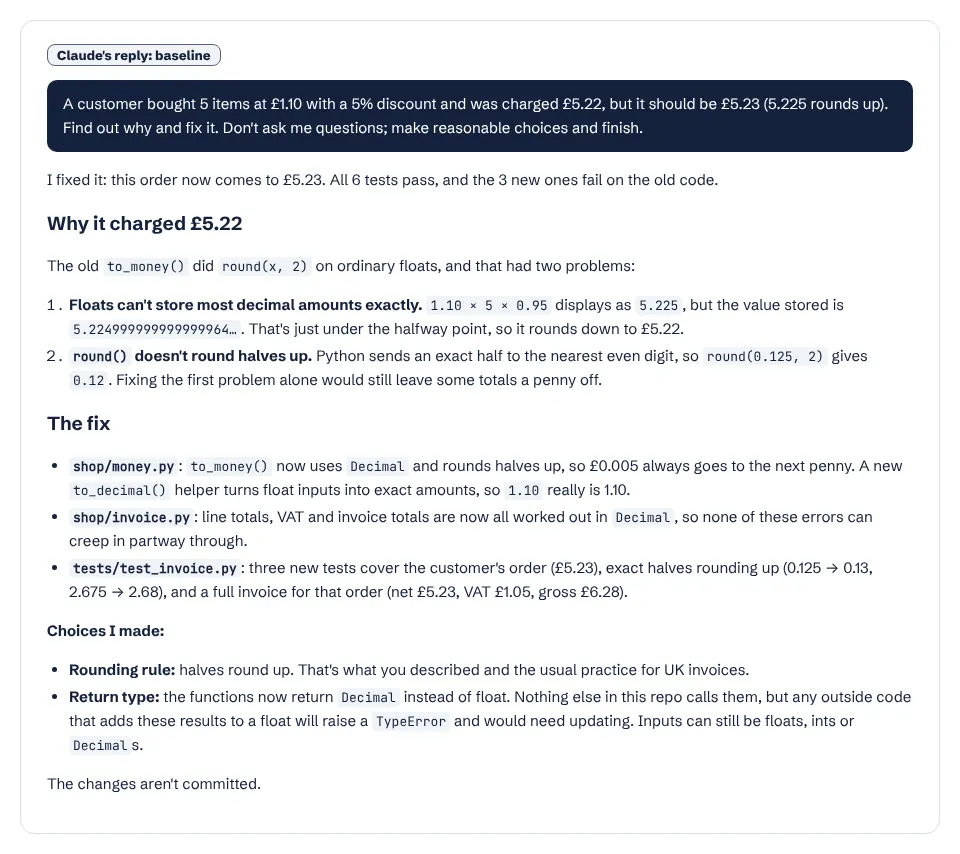
No skill (plain Claude)

Plain Claude's explanation of the rounding bug

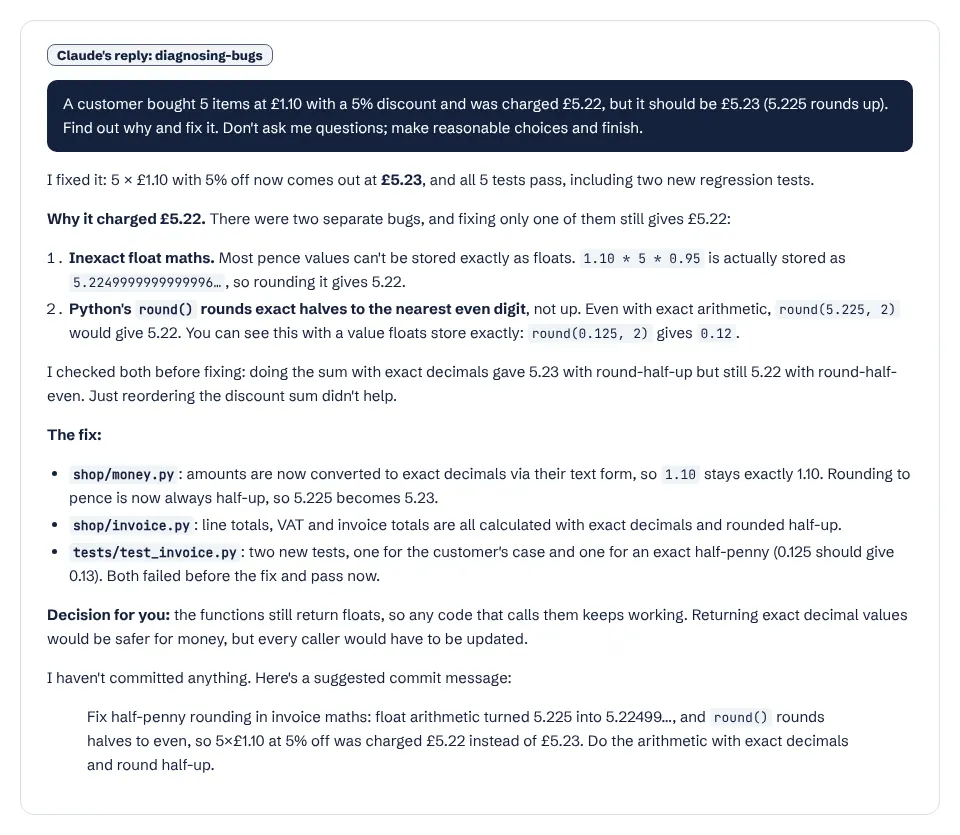
diagnosing-bugs

Explanation with Matt Pocock's diagnosing-bugs skill

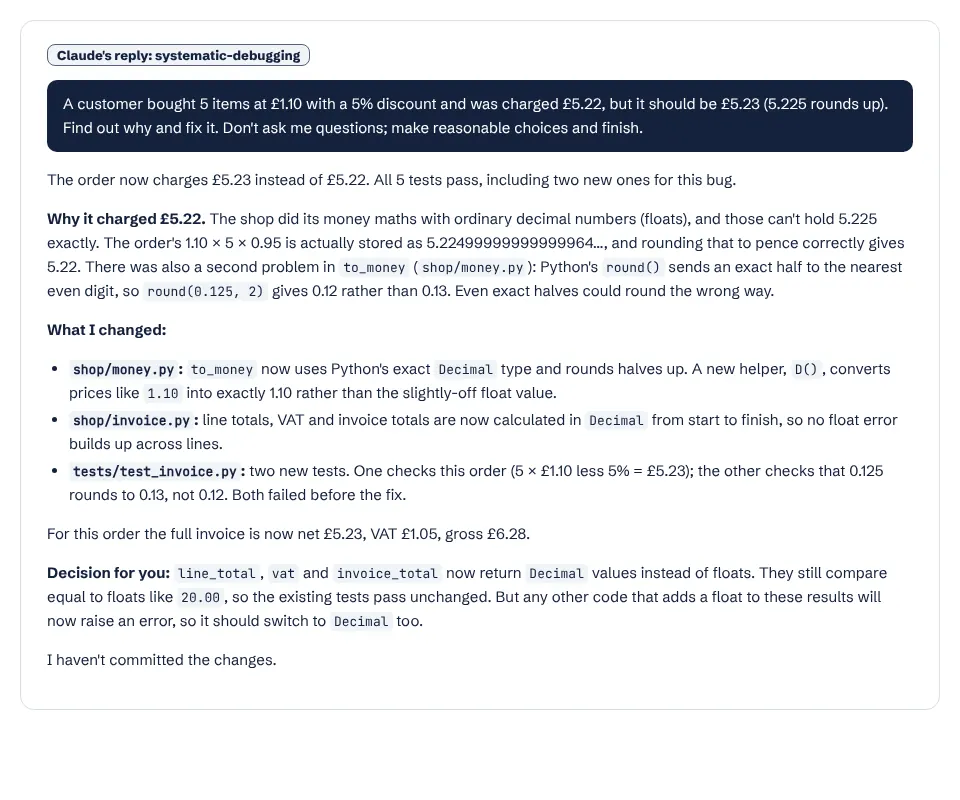
systematic-debugging

Explanation with Superpowers' systematic-debugging skill
Claude's explanation after run 1 of each. All three name the same two causes.

No skill (plain Claude)

Claude Code with no skill installed

  • Found both causes and fixed the shared helper and the maths that feeds it.
  • Added 3 regression tests and said they fail on the old code.

diagnosing-bugs

by Matt Pocock · 936,570 installs

  • Found both causes in both runs.
  • Run 2 created a branch, fix/half-penny-rounding, and committed the fix without being asked.

systematic-debugging

by Jesse Vincent · 335,291 installs

  • Found both causes in both runs.
  • Added 2 or 3 regression tests that failed before the fix.

Each skill was installed alone with its own install command in a fresh folder, and the same prompt was run 2 times per skill plus 2 times with no skill, in Claude Code 2.1.326 in headless mode on November 17, 2026. Results come from checks we ran after each run: a hidden suite of 12 tests covering the reported case, other half-penny line totals and the same bug in VAT, which the report never mentioned. How we test skills. Every skill we have tested.

Each skill is made and maintained by its own author, named above. SkillsBot.org is an independent directory and is not affiliated with any of them.

What the test showed

On a bug contained in one small module, the skills did not change the result: every run found the cause, fixed a related bug nobody had reported, and added regression tests. Plain Claude did the same.

When these skills should matter

Both skills are written for hard bugs. Superpowers' systematic-debugging forbids any fix before the root cause is found and works in four phases: root-cause investigation, pattern analysis, testing one hypothesis at a time, then the fix. Matt Pocock's diagnosing-bugs puts building a fast pass/fail feedback loop first, then reproducing and minimising the bug, forming hypotheses, instrumenting, and fixing with a regression test.

That discipline pays off on bugs that are slow to reproduce, intermittent, or spread across systems. We plan to test them on a harder bug.

Debugging Skills Compared: FAQ

Which debugging skill is better?

On our rounding bug, neither: both, and plain Claude, found both causes and fixed them. Choose by approach: systematic-debugging for root-cause-first rules, diagnosing-bugs for building a feedback loop first.

Does diagnosing-bugs commit changes?

In one of our two runs it committed the fix on a new branch without being asked. Its checklist asks for the correct hypothesis to be stated in the commit or PR message.

Are these skills worth installing?

For everyday bugs, our test found no gain. They are meant for hard bugs where a disciplined process saves time.